


Performances:
April 2012 - National Museum of Colombia, Bogota, Colombia
May 2011 - Mario Laserna Auditorium, University of the Andes, Bogotá Colombia.
Litany for the Whale, John Cage (1981)
Multimedia Performance
Experimental Vocal Ensemble of The Andes (eeva)
DMA Carolina Gamboa Hoyos, Conductor

“Litany for The Whale” is a work composed by John Cage (1912 - 1992) in 1980. In between 2011-2012, the Experimental Vocal Ensemble of The Andes presented a multimedia performance of this work at the National Museum of Colombia (April 2012), the Mario Laserna Auditorium (May 2011) and the Santa Clara Museum-Church (May 2011) (Bogotá, Colombia). The Ensemble is currently conducted by DMA Carolina Gamboa Hoyos since 2010 at the University of Los Andes (Bogotá, Colombia).
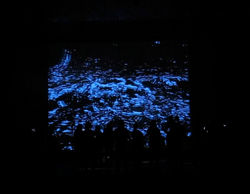
The performance of this work included the use of live multimedia, which developed interactively according to the ensemble’s live input. The ultimate goal is that amplified voices, video and sound objects create together an evolving environment based on control computations (such as envelope following) and the use of controlled randomness, as proposed originally by Cage.
In order to do so, audio and video processing techniques were programmed in Pure Data through a computer-based network of patches. Fundamental is a chain of cooperation between voices, transducers and computers as depicted in the figure below:
Performances:
April 2012 - National Museum of Colombia, Bogota, Colombia
May 2011 - Mario Laserna Auditorium, University of the Andes, Bogotá Colombia.
GO TO THE EXPERIMENTAL VOCAL ENSEMBLE OF THE ANDES WEBPAGE HERE

The chain works as follows: voices are amplified and processed with discrete reverberation on a mixer device. Direct outs in the mixer device allow to use this as well as control signals for the production of video and new sampled-based sound objects. In order to pursue musical relation, the compositional method in the original score (i.e. “words”), is used as well to conduct the generation of signal-processing-based material, in a constantly evolving ambience.
Hoyos presented this work as the first part of a programme named “Water”, which included as well other pieces of contemporary music written by composers as Luciano Berio, M. Schafer and Michael Pisaro.

 |  |  |
|---|---|---|
 |  |  |
 |